
And Soy it Begins...
1100 BC
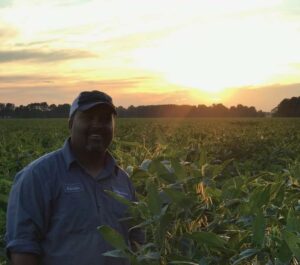
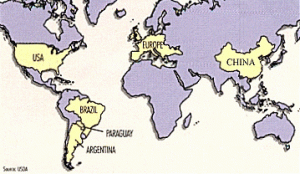
Soybeans originated in Southeast Asia and were first domesticated by Chinese farmers around 1100 BC. By the first century AD, soybeans were grown in Japan and many other countries.
1700s
Soybean seed from China was planted by a colonist in the British colony of Georgia in 1765. Soy sauce had been popular in Europe and the British colonies in America before soybean seeds arrived.
1851
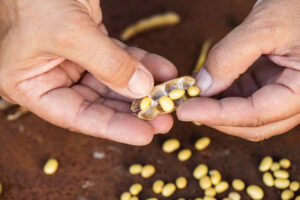
It wasn’t until 1851 that soybean seeds were distributed to farmers in Illinois and the corn belt states. This seed was a gift from a crew member rescued from a Japanese fishing boat in the Pacific Ocean.
1870s
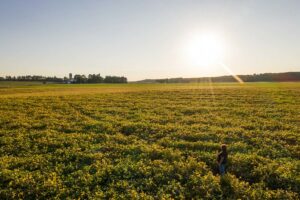
In the 1870s soybeans increased in popularity with farmers who began to plant them as forage for their livestock. The plants flourished in the hot, humid summer weather characteristic of North Carolina. By the turn of the century, the United States Department of Agriculture was conducting tests on soybeans and encouraging farmers to plant them as animal feed.
1904
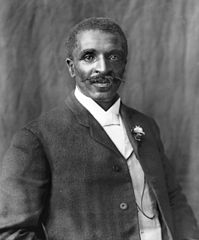
American chemist, George Washington Carver discovered that soybeans are a valuable source of protein and oil. He also realized the benefits of soybeans for preserving good quality soil. Mr. Carver encouraged cotton farmers to “rotate” their crops in a three-year plan so that peanuts, soybeans, sweet potatoes or other plants would replenish the soil with nitrogen and minerals for two seasons, and then the third year farmers planted cotton. To the surprise of many farmers, this produced a far better cotton crop than they had seen for many years!
1919
William Morse co-founded the American Soybean Association and became its first president. At the time farmers used only 20 proven varieties of soybeans. Morse recognized that there was much potential to be discovered in the soybean plant.
1929
In 1929, Morse spent two years gathering soybeans in China. He brought back more than 10,000 soybean varieties for agricultural scientists to study. Morse understood that new, improved varieties meant better production for farmers.
1953
Henry Ford went to his research lab the lab one day with a bag of soybeans. He dumped them out on the floor and told the scientists, “You guys are supposed to be smart. You ought to be able to do something with them.” In time, the scientists in Ford’s lab made a soy-based plastic strong enough for the gearshift knobs, horn buttons, window frames, accelerator pedals, light-switch assemblies and ignition-coil casings. They also fashioned the exterior of an automobile from “soybean plastic.” By 1935 Ford was using one bushel of soybeans for every car he manufactured.
1940s
It wasn’t until the 1940’s that soybean farming really took off in America. Soybean production in China, the major supplier at that time, was halted by World War II and internal revolution. When the United States entered the war, the steep increase in demand for oils, lubricants, plastics and other products greatly increased the demand for soybeans.
1950s
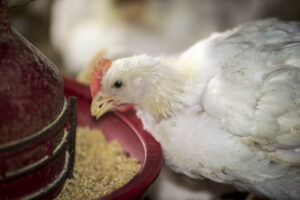
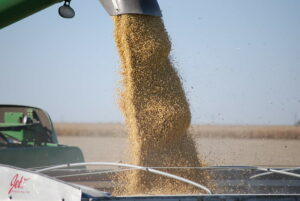
Following the Second World War, the United States experienced a period of increasing prosperity. Demand for meat consumption increased as people’s diets improved. Livestock producers found that soybean meal was the preferred source of protein at an affordable cost. Chickens, turkeys, cattle and hogs were fed diets containing tens of millions of tons of soybean meal each year.
1990s
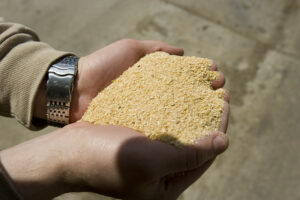
One of the great scientific advances in agriculture was the improvement of the soybean in the 1990s to withstand herbicides. This meant that farmers could control weeds without killing the soybean plant. They wouldn’t have to cultivate the fields with steel implements, which meant less soil erosion, less fuel expended, and more yield per plant. The technology has allowed U.S. farmers to become suppliers to the world at a time when global demand for food is reaching unprecedented levels.
Today
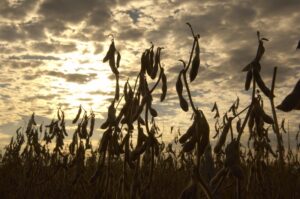
Thirty-one U.S. states have a soybean production industry. The top producers are the states of Iowa, Illinois, Indiana and Minnesota. North Carolina in comparison produces about one-tenth of the volume of soybeans produced in Iowa, but North Carolina produces many other crops besides soybean. A typical North Carolina soybean farmer might also grow corn, wheat, cotton, tobacco, sweet potatoes or peanuts. North Carolina has one of the largest pork and poultry industries in the world. As a net importer of soybeans and soybean meal, North Carolina ranks as high as many entire countries!